Hi all,
Structured products are becoming increasingly sophisticated, with payoffs and cash flow mechanisms that vary widely across asset classes and product types.
For teams involved in structuring and booking, the challenge is not only to model these products, but to do so in a way that is efficient, consistent, exhaustive and easy to use in practice - from booking to reporting.
LexiFi’s architecture has long combined two complementary approaches: dedicated instruments for common structures, and the DIY (Do It Yourself) instrument.
The DIY instrument is a robust and fully integrated framework offering a high degree of flexibility while preserving the same validation, consistency, pricing, and lifecycle guarantees as all other instruments.
The distinction is therefore not about functionality - both approaches rely on the same core capabilities and processing framework - but about usability and operational workflows.
While the DIY instrument makes it possible to model highly customized structures within a controlled and validated framework, it can be less intuitive to configure and less naturally suited for standardized reporting workflows, since structures are not tied to predefined market-recognized product templates.
This is where standard instruments play a complementary role.
LexiFi continuously evolves its platform by combining client feedback with a broader understanding of market practices. When similar structuring patterns emerge repeatedly across clients, asset classes, and term sheets, they are progressively integrated into standard instruments.
This ability to generalize recurring patterns while preserving the full flexibility of the DIY framework is a core part of LexiFi’s product approach.
The latest enhancements build on that foundation by bringing frequently used booking patterns directly into regular instruments - combining the flexibility of the DIY framework with simpler and more intuitive workflows.
This reduces fragmentation, brings booking closer to how products are actually described in term sheets, and simplifies reporting and data usage by exposing key payoff components directly through calculated attributes, rather than embedding them in custom formulas.
Making LexiFi Autocall instruments more native
A number of structuring patterns that were previously configured through the DIY instrument are now supported directly within the Autocall instrument.
For example:
- Bearish redemption scenarios can now be defined natively, with early redemption triggered when all underlyings fall below their autocall levels, and coupon conditions adjusted accordingly.
- Booster floor mechanisms introduce a configurable minimum on the early redemption amount, floored at 100% plus the worst-performing underlying’s return since inception - directly with predefined parameters, without overlays or formulas.

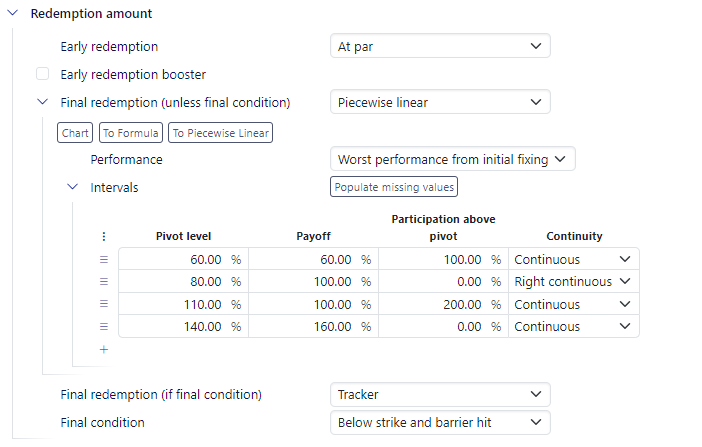
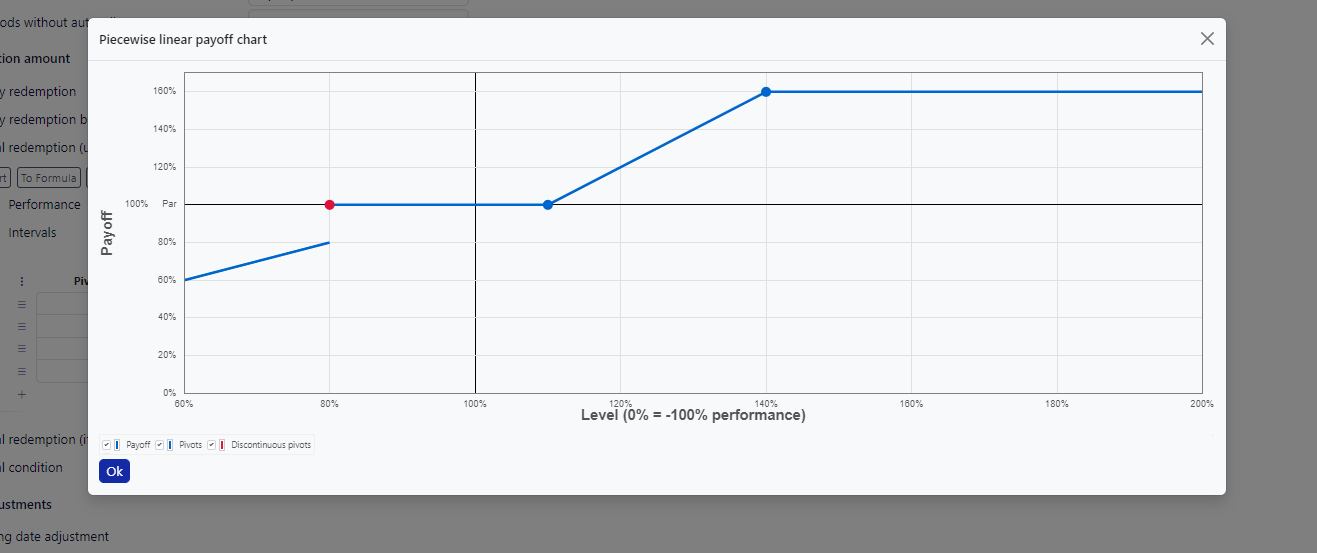
- Piecewise payoff structures allow the payoff at maturity to be defined segment by segment, with each segment determined by a base level, a participation rate, and a pivot level.
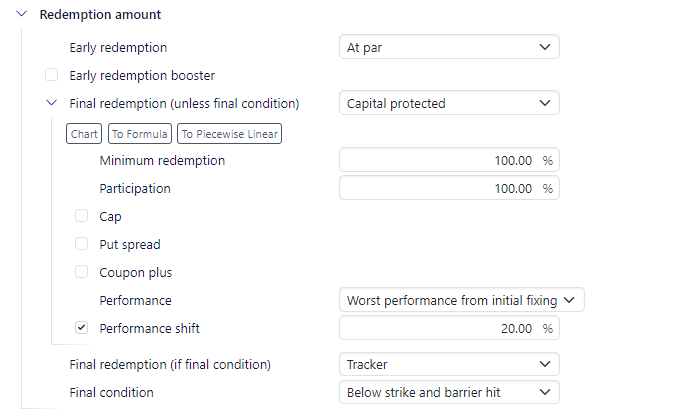
- Performance shifts can be applied directly within the payoff construction, adjusting the underlying performance before participation, cap/floor, and capital protection are calculated. This makes it easier to model buffers, performance offsets, and other scenarios at maturity as specified in term sheets.
Taken together, these enhancements make it easier to represent a wide range of yield enhancement features within the Autocall instrument in a more transparent and maintainable way.
Extending the same approach to rate instruments
The same approach is being applied beyond the Autocall instrument.
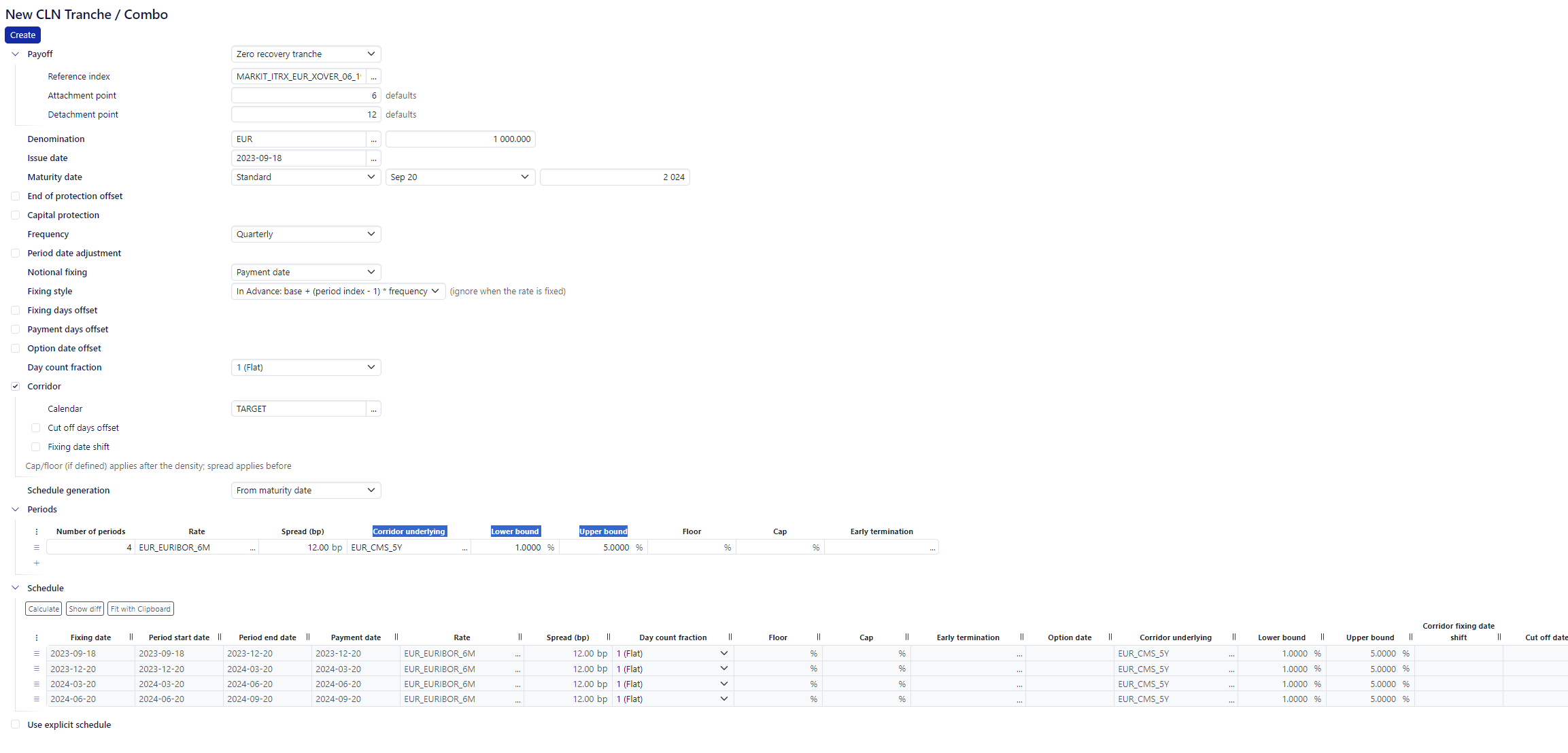
Range accrual coupon features are now supported directly within Floating Rate Notes and Credit Linked Notes.
Rather than relying on separate instruments, these structures can now be booked within existing product instruments - reducing fragmentation and improving consistency across instruments.
Simplifying basket definitions across products
Some improvements apply more broadly across all structured products.
Performance baskets can now be defined using weights that do not need to sum to one, with normalization handled automatically by the engine.
This allows users to work with weights exactly as they appear in term sheets - whether expressed as percentages, notionals, or relative exposures - without additional transformations.
The result: a more consistent booking framework
Across all these changes, a common thread emerges: a shift from custom formulas to structured parameters, from product-specific setups to reusable frameworks, and from fragmented instruments to more unified booking approaches.
One concrete consequence of this shift is a direct improvement in reporting and data usage. Because key payoff components are now defined through structured parameters rather than embedded in formulas, they are directly available as calculated attributes - removing the need to parse or extract information from custom formula logic. This makes reporting pipelines simpler, more reliable, and easier to maintain.
This gradual process of bringing market-proven structures into native instruments is not new at LexiFi - it is how the platform has always grown. As structured products evolve and new patterns gain traction, LexiFi’s ability to translate that market knowledge into native, intuitive booking workflows is what sets it apart. And for structures that fall outside these patterns, the DIY instrument ensures that no product is ever out of reach.
| What we're reading |  |
New blog: Structured products rolls - how lifecycle anticipation boosts client engagement. | |
| What we're watching |  |
Understanding LexiFi's approach to financial contract description  Watch in English Watch in French | |
| Client stories |  |
LOMBARD ODIER: Frederic Lehner, Vice President - Structured Products Advisory at Lombard Odier, gives an overview on LexiFi Apropos’ use cases within the bank. SILEX: Alexis de Bernis, Chief Technology Officer at Silex, speaks about Silex’s main achievements with LexiFi Apropos, and more | |
| Features in focus |  |
Workflow Structured Products Definitions |