Hi all,
Have you ever wondered why pricing twenty similar contracts should require twenty separate computations?
The question is becoming increasingly relevant as quantitative workloads continue to grow. Regulatory requirements, evolving market practices, and risk management needs are driving more pricing calculations, scenarios, sensitivities, and risk measures across increasingly large populations of products.
For large portfolios, the challenge is therefore not only the number of contracts being processed, but also the growing number of calculations that must be completed within constrained processing windows, often without a proportional increase in computing resources.
At the same time, many of these contracts are different products from a business perspective but share strong similarities from a quantitative one: variations of an autocall built on the same basket, families of CMS-linked structures, or collections of products sharing the same pricing model and market assumptions.
While their payoffs may differ, much of their quantitative context remains identical - yet most systems still analyse them independently.
When similar analyses repeat the same work
LexiFi provides template functions that allow pricing, scenarios, Greeks, and other quantitative measures to be executed programmatically across large populations of contracts, enabling powerful automation and large-scale quantitative analysis.
LexiFi supports several pricing approaches. Here, let’s consider its widely used Monte Carlo framework. Under a traditional workflow, each contract follows the same sequence of steps, including but not limited to:
- Retrieving the required market data
- Calibrating the pricing model
- Generating Monte Carlo trajectories
- Evaluating the contract payoff
- Producing outputs such as prices, confidence intervals, Greeks, or risk measures
For an individual contract, this workflow is perfectly appropriate. At scale, however, the performance challenge comes not only from the number of contracts being processed, but also from the growing number of calculations required across them.
Regulatory requirements, market practices, and risk management needs increasingly involve more scenarios, sensitivities, and portfolio-level calculations, such as those required for SIMM. For large portfolios, completing this expanding computational workload within limited processing windows - often overnight - can become a significant operational constraint.
When many of these contracts also share the same quantitative foundations - such as the pricing model, market-data configuration, underlying universe, or calibration assumptions - this creates often important opportunities to share at least big parts of the computations they have in common.
In these situations, a significant amount of computational effort can be avoided - not by simplifying the analysis, but by preventing the same work from being performed repeatedly.
Where the cost really lies
In Monte Carlo frameworks, not all computational steps carry the same cost. Generating market trajectories is typically the most expensive part of the calculation: thousands - and sometimes millions - of simulated paths may be required before any payoff can be evaluated. By comparison, once these trajectories exist, evaluating additional payoffs becomes relatively inexpensive.
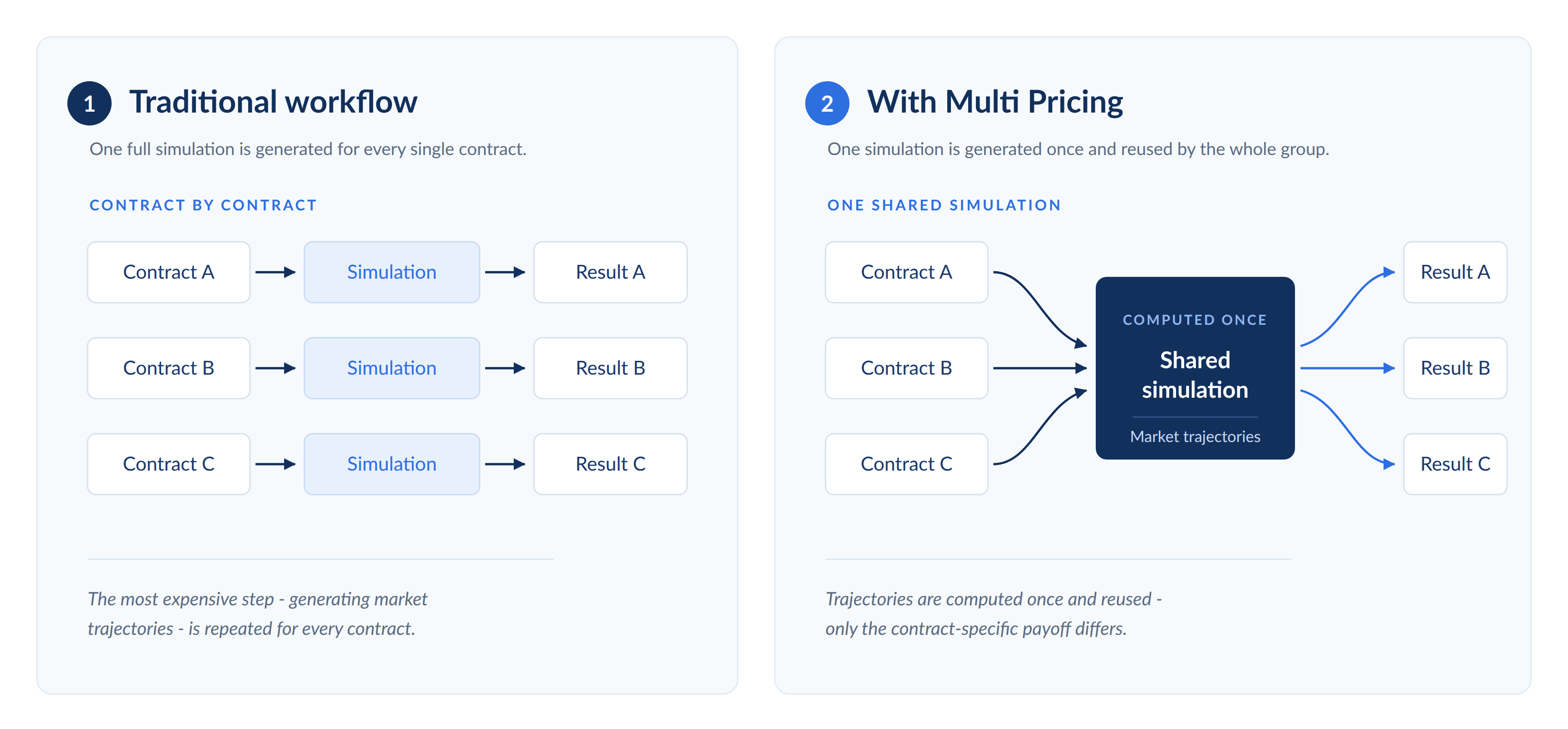
This creates an asymmetry: many contracts may differ at the payoff level while sharing exactly the same simulated market environment, yet traditional workflows continue to regenerate those trajectories independently for every contract.
A shared simulation framework
LexiFi is introducing Multi Pricing as a new product capability designed to address this challenge. It provides a shared simulation framework in which contracts can be grouped according to common quantitative characteristics - pricing model, market-data setup, underlying universe, calibration assumptions and quantitative adjustments.
Rather than treating each contract as a completely independent problem, Multi Pricing recognises that many contracts belong to the same quantitative family. Each family is then evaluated through a shared Monte Carlo simulation: the underlying trajectories are generated once and reused across all contracts participating in the analysis, and the contract-specific variations are applied independently afterwards.
In practice, the difference is simple:
From pricing to quantitative analytics
Although Multi Pricing is particularly effective for mass pricing, the same shared simulation framework extends naturally to a much broader set of quantitative workflows:
- Scenarios
- Greeks (Delta, Gamma, Vega, Theta)
- portfolio measures
- stress testing
- Value at Risk (VaR) and Conditional Value at Risk (CVaR)
- large-scale quantitative research
The benefits become particularly visible when analysing large populations of related contracts:
- variations of yield enhancement products (e.g. autocalls) on the same basket
- variations of FRNs linked to CMS or CMS spreads
- structured products sharing the same quantitative environment
- large parameter studies and exploratory analyses
Here again, contracts may appear different from a business perspective while remaining largely similar from a quantitative one. Multi Pricing leverages this common foundation to avoid repeating the same simulation work across the entire population.
Result consistency across Monte Carlo runs
Multi Pricing combines computational efficiency without loosing the statistical robustness of Monte Carlo pricing.
Because all contracts within a group are evaluated on a common set of simulated paths, the point estimate obtained for a given contract may not exactly coincide with the one produced by a standalone pricing run, which relies on a different set of random paths.
Both approaches nevertheless preserve the convergence properties of the Monte Carlo method: their estimates remain statistically consistent with the same theoretical value, with coherent confidence intervals.
Where greater consistency across different contract sets is required, LexiFi provides homogenisation mechanisms that reduce variations between shared simulations while preserving much of the performance benefit of shared computation.
Making large-scale quantitative analysis practical
For quantitative teams, the benefit of Multi Pricing is not limited to accelerating individual calculations. It makes it possible to process large populations of related contracts without repeating the same simulation for each instrument.
This becomes increasingly relevant as regulatory requirements, risk management practices, and market standards require more scenarios, sensitivities, and portfolio-level calculations to be completed within constrained processing windows. By performing the common simulation once and applying each contract’s specific payoff logic afterwards, teams can absorb larger workloads, broaden the scope of their analyses, or run calculations more frequently without a proportional increase in computing requirements.
Multi Pricing therefore addresses a practical scaling challenge: meeting growing quantitative and risk-analysis requirements without multiplying redundant computation.
| What we're reading |  |
New blog: Structured products rolls - how lifecycle anticipation boosts client engagement. | |
| What we're watching |  |
Understanding LexiFi's approach to financial contract description  Watch in English Watch in French | |
| Client stories |  |
Our latest client Stories | |
| Features in focus |  |
Pricing OTC derivatives and structured products Structured Investments risk and what-if scenarios |