Multi Pricing lets quantitative teams scale large simulation workloads by computing the shared part of related contracts once and reusing it across the group, while each contract keeps its own analysis and outputs.
Quantitative workloads increasingly involve analysing large populations of contracts - across pricing, scenarios, sensitivities, and risk measures. When many of these contracts share the same quantitative foundations, running a complete Monte Carlo simulation for each one independently creates unnecessary computational overhead.
Multi Pricing removes that overhead by generating the market trajectories once for a group of related contracts and reusing them to evaluate each contract individually.
Key capabilities
- Shared Monte Carlo simulations across compatible contracts
- Grouping of contracts with common quantitative characteristics
- Reuse of simulated trajectories and intermediate calculations
- Contract-specific payoff evaluation and outputs
- Support for pricing, Greeks, scenarios, and portfolio analytics
- Integration with LexiFi’s contract algebra and template language
- Homogenisation mechanisms for greater consistency across contract sets
- Designed for mass pricing, portfolio analysis, and large-scale quantitative workloads
From independent calculations to shared computation
In a traditional Monte Carlo workflow, each contract is processed independently.
The pricing engine retrieves the required market data, calibrates the model, generates simulated trajectories, evaluates the payoff, and produces the requested outputs.
This approach is appropriate for an individual valuation. At portfolio scale, however, the same computationally intensive steps may be repeated hundreds or thousands of times across contracts that share the same:
- pricing model
- market-data configuration
- underlying universe
- calibration assumptions
- quantitative adjustments
- credit spread assumptions
Multi Pricing identifies these common quantitative foundations and makes it possible to reuse the corresponding calculations instead of performing them separately for every contract.
Grouping compatible contracts
Contracts that can share computations are organised into homogeneous quantitative groups.
For example, a group may contain:
- variations of yield enhancement products (e.g. autocalls) on the same basket
- FRNs linked to the same CMS or CMS-spread environment
- structured products using the same pricing model and market assumptions
- the same structure under different payoff configurations
Each group can then be processed using a common simulation framework.
The objective is not to make the contracts identical. Their payoff definitions and individual outputs remain distinct. It is to identify the part of the quantitative workload that they already have in common.
One simulation, multiple contract-level results
For each compatible group, Multi Pricing runs the common Monte Carlo simulation once.
The platform can:
- generate the required market trajectories
- compute discount factors and intermediate observations
- store the information required for payoff evaluation
- reuse this information across the contracts in the group
- produce individual prices, confidence intervals, sensitivities, and risk measures
Each contract is then evaluated using its own payoff logic, while benefiting from the shared computation.
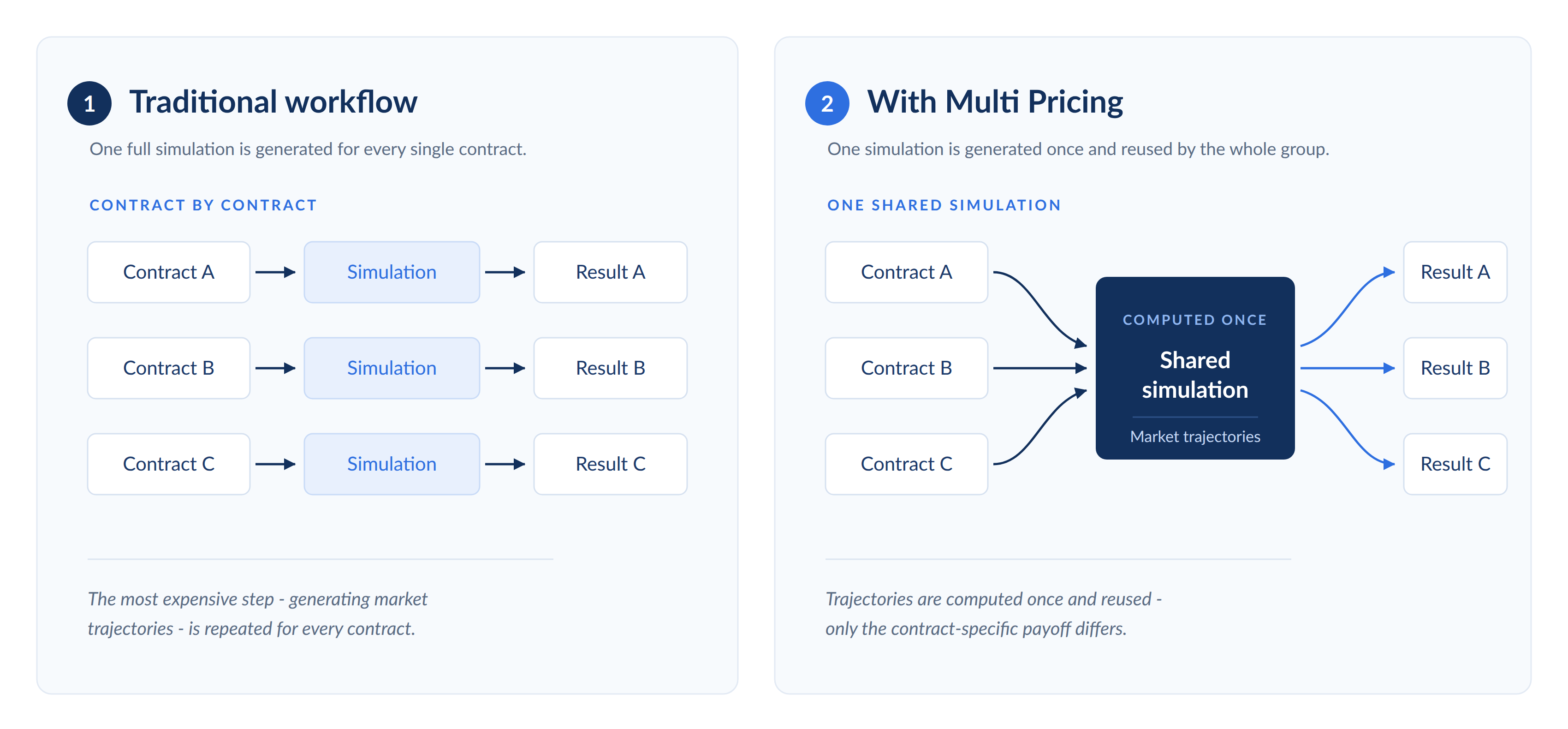
Traditional workflow versus Multi Pricing: in the traditional workflow a full simulation is generated for every single contract; with Multi Pricing the market trajectories are computed once and reused across the whole group, with only the contract-specific payoff differing.
Leveraging LexiFi’s contract algebra
As an alternative route to the same goal, Multi Pricing can also use LexiFi’s contract algebra.
Compatible contracts can be represented together as a single composite, multi-leg contract. LexiFi’s template language then evaluates the combined structure while retrieving the information and results associated with each individual component.
This reuses the common computation while keeping contract-level information accessible - the difference being that the contracts are evaluated together as one structure, rather than grouped as separate contracts.
Beyond pricing
Although the name is Multi Pricing, the approach is not limited to producing prices.
The same shared quantitative framework can support:
- scenario calculations
- Greeks, including Delta, Gamma, Vega, and Theta
- portfolio measures
- stress testing
- Value at Risk (VaR)
- Conditional Value at Risk (CVaR)
- large-scale quantitative research
- exploratory product analysis
This becomes particularly valuable as regulatory, market, and risk-management requirements generate increasingly large numbers of calculations.
Performance at scale
The performance benefit comes from avoiding repeated simulations.
In Monte Carlo frameworks, generating market trajectories is generally far more computationally intensive than applying an additional payoff once those trajectories are available.
By sharing this part of the calculation across compatible contracts, Multi Pricing can:
- reduce the number of simulations required
- lower CPU consumption
- accelerate mass-pricing and portfolio-analysis workloads
- accommodate larger numbers of scenarios and sensitivities
- make better use of available overnight processing windows
As portfolio sizes increase, computational effort grows with the number of distinct quantitative configurations rather than with the total number of contracts. The benefit increases further when large populations of contracts share substantial parts of their quantitative environment.
Result consistency
Multi Pricing preserves the statistical properties of Monte Carlo pricing.
Because contracts within a group are evaluated using a common set of simulated paths, the point estimate for an individual contract may not exactly coincide with the estimate obtained through a standalone Monte Carlo run based on a different set of random paths.
Both approaches nevertheless preserve the convergence properties of the Monte Carlo method and remain statistically consistent with the same theoretical value, with coherent confidence intervals.
Where greater consistency across different contract sets is required, LexiFi provides homogenisation mechanisms that reduce variations between shared simulations, with some additional computational cost.