Individual product complexity isn’t what slows a structured products business down. Fragmentation and heterogeneity are.
Structured products are complex by nature. But as the business grows, the real challenge shifts: it’s the diversity of products implying multiplication of lifecycle events, valuations, reporting, users, and workflows that comes with scale. When each relies on separate tools or local processes, growth turns into fragmentation - spreadsheets to maintain, information to reconcile, product logic rebuilt across applications.
LexiFi’s answer: handle diversity and complexity at the level of the architecture, not the users or operations around it. At the core of the platform is a unified symbolic representation of financial contracts, generic across asset classes, powering every calculation, process, and workflow the institution needs.
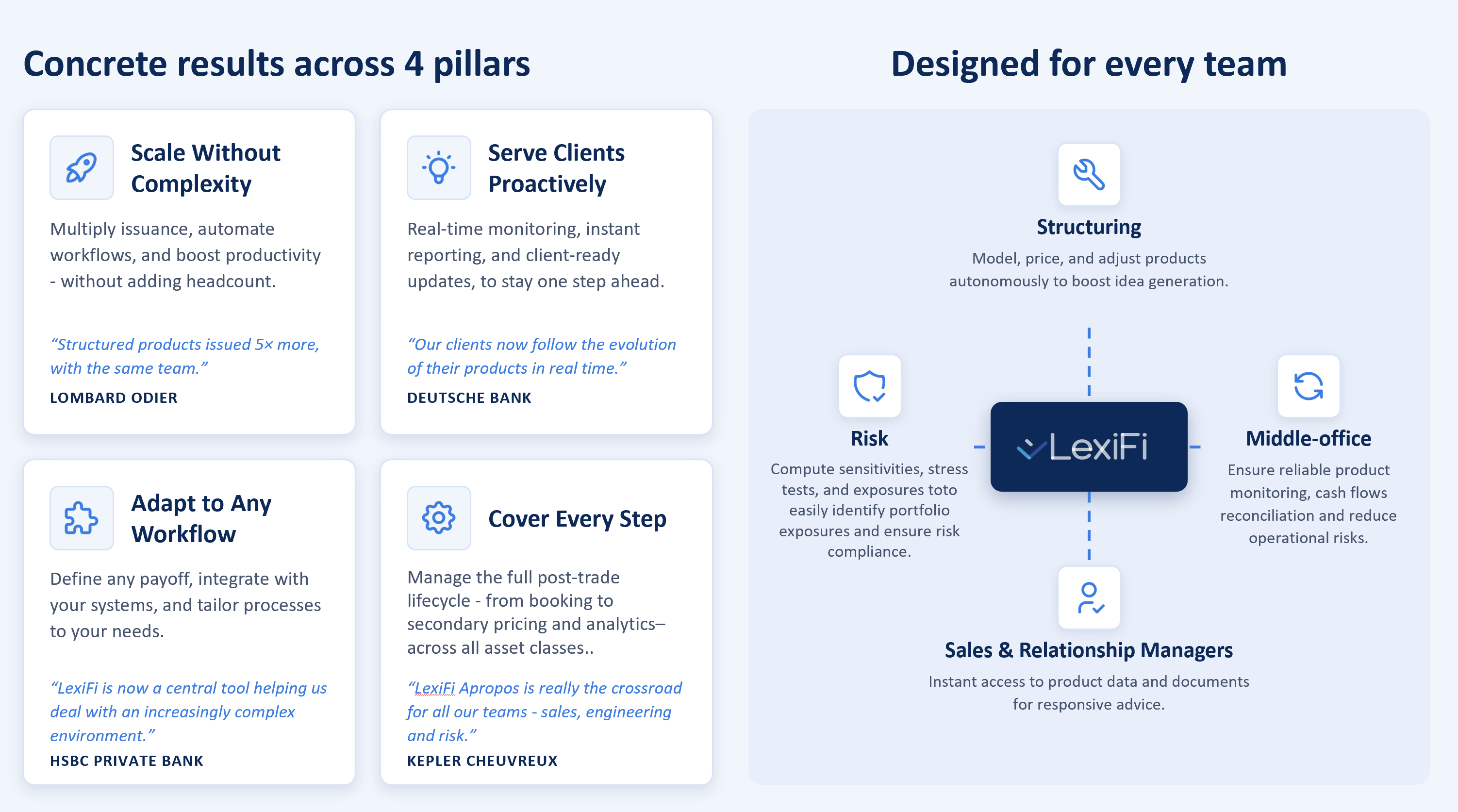
Four connected dimensions follow from this: scaling without multiplying complexity, adapting to different workflows, extending intelligence to a broader population of users, and managing products consistently from booking to maturity.
Scaling without adding complexity
Growth has traditionally meant adding resources around existing processes - more spreadsheets, more manual interventions, more friction across Structuring, Sales, Risk, Operations, and Compliance every time a new product type appears.
LexiFi’s contract modeling layer represents products programmatically within a common framework, so once the logic exists, it’s reused across variations and across the platform’s functions - pricing, lifecycle processing, documentation, reporting, APIs - rather than rebuilt each time.
At Lombard Odier, that shift shows up directly in the numbers: “Structured products issued 5× more, with the same team.” Scaling here isn’t about processing more products - it’s about growing activity without reproducing product logic and infrastructure each time.
➡️ More in our Monthly Focus: Scaling Without Complexity.
Adapting to any structured products workflow
A common foundation doesn’t mean a single way of working. Issuers, brokers, private banks, and asset managers run different organizational structures and regulatory constraints, and workflows vary even within one institution.
LexiFi combines a unified product and data model with a full API layer and configurable workflows, so it plugs into existing systems - core banking, risk, reporting - rather than sitting apart from them.
An issuer may coordinate structuring through risk management on the platform; a private bank may extend access to relationship managers with loan-to-value tools; a broker may monitor P&L and open portfolio views to clients; an asset manager may use analytics to compare products. Different workflows, same foundation - flexibility without sacrificing consistency.
As HSBC Private Bank puts it, “LexiFi is now a central tool helping us deal with an increasingly complex environment.”
➡️ More in our Monthly Focus: Adapting to Any Workflow.
Extending intelligence across the institution
As structured products grow more strategic, more people need reliable access to product information beyond the trading desk: relationship managers advising clients, operations tracking events, risk teams needing exposures, management needing a consolidated view. The bar isn’t just availability - it’s accuracy and consistency regardless of who’s looking.
LexiFi Web extends this access without creating a separate information layer: relationship managers get near real-time valuations, event notifications, barrier monitoring, and client-ready reporting from the same data used elsewhere on the platform.
Deutsche Bank sums up what that means on the ground: “Our clients now follow the evolution of their products in real time.”
The same logic extends to operations, which get live lifecycle monitoring, and to risk, which gets independent valuations and sensitivities that feed enterprise risk infrastructure - all anchored to one source of product information.
➡️ More in our Monthly Focus: Serving Clients Proactively.
Managing the structured product lifecycle, from booking to maturity
Before execution, a product is designed, negotiated, and distributed - a phase LexiFi supports through modeling and pricing. After execution, a different challenge begins: the product may stay active for years, generating coupon payments, barrier observations, autocalls, and corporate actions, all requiring valuation, monitoring, reporting, and eventual redemption.
Every one of those post-trade functions needs to understand the same product the same way. LexiFi captures a symbolic representation of the payoff at booking, and that same representation drives every downstream calculation - valuations, lifecycle events, reporting, risk, redemption - without being rebuilt for each process.
It also means a newly modeled payoff is immediately available across all of those capabilities, and the platform integrates with whatever booking sources feed it: distribution platforms, document-parsing tools, issuer data feeds, or core banking systems.
Kepler Cheuvreux describes what that continuity looks like from the inside: “LexiFi Apropos is really the crossroad for all our teams: *on one side the sales team for everything related to product *monitoring but also marketing, the engineers for all lifecycle *management matters but also repricing, and all our risk teams **for which LexiFi allows monitoring risks and limits.”*
➡️ More in our Monthly Focus: Covering Every Step.
From a specialist platform to shared infrastructure
Each of these capabilities solves a different problem on its own - less manual work at scale, workflows that fit the institution, information reaching more users, continuity across the product’s life.
But they all draw on the same architectural principle: one representation of the contract, reused across calculations, workflows, users, and systems. That’s what lets the platform’s role extend beyond a specialist tool for structuring and valuation into shared infrastructure for the whole institution.
Structured product businesses don’t get simpler as they grow - product ranges expand, workflows diverge, more people need access, and every product keeps generating activity for as long as it’s alive. The goal isn’t to eliminate that complexity. It’s to keep it from becoming fragmentation.